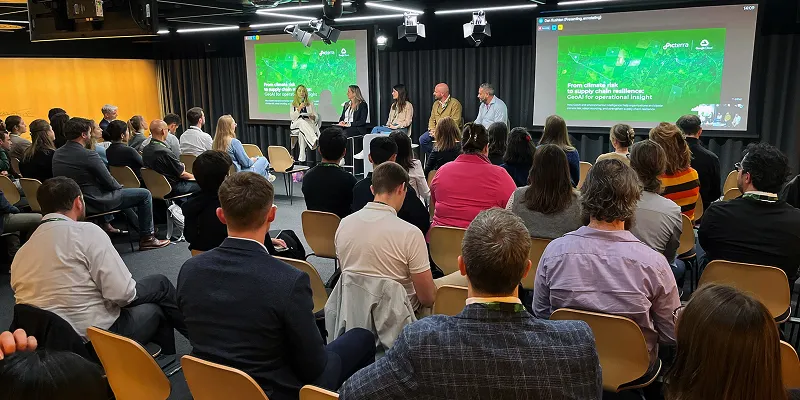

Photo from Climate Week Zurich showing a panel discussion with five speakers seated on stage before Picterra presentation slide on climate risk and supply chain resilience, with an audience listening in the foreground.

From pixels to procurement: The hard problem in GeoAI has moved

Reflections from our Climate Week Zurich session on what it actually takes to move geospatial intelligence from sustainability dashboards into sourcing decisions.

Two weeks ago, we co-hosted a session at the first edition of Climate Week Zurich with Google Cloud, titled From climate risk to supply chain resilience: turning GeoAI into operational intelligence. The room was full for the ninety-minute panel and the joint Picterra and Google Cloud demonstration that followed.

Photo from Climate Week Zurich showing a panel discussion with five speakers seated on stage before Picterra presentation slide on climate risk and supply chain resilience.

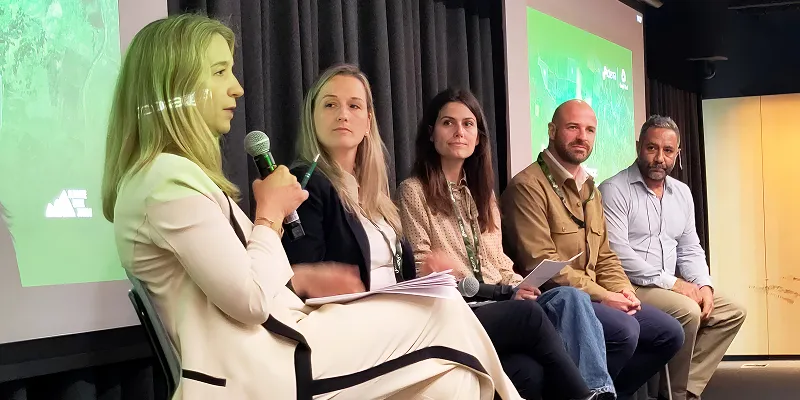
The panel brought together four lenses on the same problem:


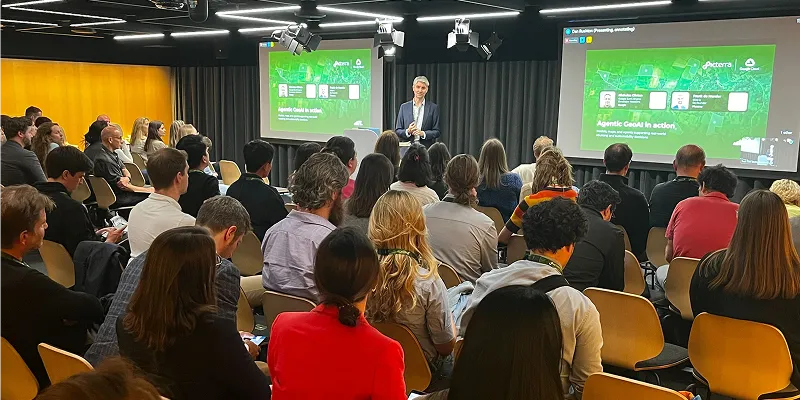
Moderated by Monika Lebkowska, our Product Marketing Lead. Immediately afterward, our COO and co-founder, Frank de Morsier, with Nicholas Clinton, walked the room through a joint demonstration of our Insights Hub platform, built on Google Cloud and Earth Engine infrastructure.

The session was held under Chatham House Rules. What follows is a synthesis of the themes that surfaced. No views are attributed to individual speakers.

We have spent the time since chewing on it. The headline observation is uncomfortable in a productive way: the data and the technology in this space are now substantially in place. The bottleneck is somewhere else entirely.

Nature positive is not a cost line

The framing that opened the panel, and recurred throughout it, was that sustainability investment is no longer a cost line on a balance sheet. For companies operating in soft-commodity supply chains, many of them more than a century old, the genuine question now is whether the same business will still exist in twenty years. That horizon reframes the conversation.

The case for a nature-positive operating model was advanced on stage as a financial argument rather than a moral one. Three axes:

Cost reduction

Regenerative agricultural practices, paired with geospatial monitoring, reduce input costs (less fertilizer, less pesticide), maintenance costs, and audit costs. Field visits are expensive and slow. Remote monitoring at scale changes the unit economics of compliance and quality assurance.

Yield resilience

A specific data point from the panel: an analysis of around 5,000 coffee farms in Indonesia in December 2025, in the aftermath of an El Niño event, found that farms implementing agroforestry practices, shade trees, and intercropping had suffered roughly 40% less damage than traditional plantings. That is a number a CFO can act on.

Value creation

Brand premium, financial market signaling, supplier relationships. Financial markets increasingly want to know what a business's plan is to thrive over the next two decades, not just the next four quarters.

Reframed this way, sustainability is no longer the cost center that procurement is asked to tolerate. It is a lens that makes procurement decisions more defensible.

Photo from Climate Week Zurich showing a panel discussion with five speakers seated on stage before Picterra presentation slide on climate risk and supply chain resilience, with an audience listening in the foreground.

What is actually working today

The clearest examples on the day came from FMCG operations that have spent years building their own ground truth. One sustainability program described how it monitors a large cocoa supply base across West Africa, with field visits still required but increasingly directed by geospatial prioritization. The question is no longer whether to visit a farm. It is which farms to visit, in what order, for what reason.

Two specific applications stood out.

The first: agroforestry monitoring. Tracking whether planted trees actually survive the first year is essential both for carbon accounting under the GHG Protocol Land Sector and Removals guidance and for the integrity of agroforestry claims. Geospatial AI flagging farms with low seedling survival means field teams can focus on replanting where it matters most, rather than re-surveying farms where the trees are doing well.

The second: deforestation alert triage. Every company sourcing soft commodities now receives alerts from one provider or another. The problem is no longer the absence of alerts. It is that many are false positives, and that different providers often disagree. Pairing automated alerts with AI-assisted imagery review before sending a field team materially reduces the cost per investigated alert. It also raises the bar on what counts as actionable.

In both cases, the technology is augmenting existing expertise. It is not replacing the field team or the agronomist. It is making both more useful.

The honest gap: dashboards do not change decisions

The most pointed line of the afternoon, paraphrased: a geospatial dashboard, however sophisticated, rarely changes a procurement decision on its own.

This was the thesis the panel kept returning to. The technology is largely there. The data is largely there. What is missing is the operational connective tissue that turns a signal into an action.

Four ingredients were identified as necessary for operationalization:

  1. The insight itself. Available, accurate, defensible.
  2. A named owner. A specific person whose job it is to act on the insight.
  3. A defined action. What does the owner actually do when the signal appears? Cancel the order? Audit the supplier? Escalate to procurement?
  4. Integration into the workflow. The signal has to reach the system where the decision is made. ERP, supplier management, procurement workflow. A dashboard that sits next to those systems but isn’t connected to them is just decoration.


Three reasons this commonly fails were named on stage.

Trust

In a large organization, multiple teams use various data sources to monitor similar metrics. An alert from one source may not match an alert from another. Without an agreed source of truth, even a well-owned insight stalls in cross-team debate. A supplier presented with conflicting alerts has every reason to dispute them.

Fragmentation

Different teams, different software systems, different timelines. Sustainability and supply chain teams often use the same underlying data inputs to produce two entirely different outputs, for two entirely different audiences, in two entirely different review cycles. They have less ability to learn from each other than the data layer would suggest.

Integration

A dashboard, however accurate, that does not push its output into the supplier management system or the procurement workflow is unlikely to change a procurement decision. The output has to live where the decision is being made, in the form the decision-maker already works in.

None of these is a technology problem. They are organizational ones.

Plot-level resolution is no longer optional

A second thesis ran through the conversation: aggregated data is no longer enough.

For companies that source physical goods from physical places, decisions made on country-level or regional-level averages will increasingly be wrong. That is no longer just an analytics gap. It is a material risk management problem. Field-level variation is the substance of the supply chain, not the noise. A coffee field on a steep, well-exposed slope behaves differently from a flat field two hundred meters away in a frost-prone valley. A cocoa farm with hedgerows and wind protection behaves differently from a neighboring farm without them. Aggregation hides what matters, and what aggregation hides is exactly where risk concentrates. Risk mitigation begins with recognizing the exception, not averaging it out.

The case for plot-level intelligence is the same one made for ground-truth data more broadly. When buying decisions and sustainability investments are made based on the underlying physical reality of fields, approximations of approximations are no longer acceptable. The technology to deliver plot-level intelligence at a global scale is now mature. What was novel a few years ago, the ability to extract decision-grade signals from satellite imagery at field resolution, is becoming standard practice.

The harder problem now is consistency at a global scale. Producing comparable, defensible results across Brazil, Indonesia, and Côte d’Ivoire every week, with accuracy that would withstand a regulator or an auditor, is a different category of problem from running a model in a single region. That is the work that has been quietly going on for a decade in this category. It is also the work that does not show up in a demo.

A useful litmus test came up implicitly in the Q&A: if your sourcing intelligence cannot tell you which side of the valley one of your suppliers’ farms sits on, you do not yet have plot-level intelligence. You have a label.

Where agentic AI actually earns its place

A theme that surfaced in both the panel and the demo: it is no longer interesting to ask whether agents can reason about geospatial data. They can. The interesting question is which kind of reasoning is most operationally useful.

Two patterns emerged.

The first is the analyst-style agent: take a polygon, a question, and a set of data sources, and produce a structured answer. EUDR due diligence reports. Carbon accounting at the land management unit level. Risk explanations for a single plot, citing the upstream data. These are valuable because they compress hours or days of expert analyst time into minutes, while preserving traceable references back to the underlying data.

The second is the surfacing-style agent: scan the entire supply chain on a recurring cadence, identify which plots or regions show meaningful change, and surface them to the human team. A weekly digest of what has shifted, what is at risk, and what warrants investigation. The premise here was articulated cleanly on stage: most decision-makers do not have time to interrogate a chatbot every week. The signal has to come to them, prioritized, with reasoning attached.

Photo from Climate Week Zurich showing Frank de Morsier presenting on stage in front of slides about climate risk and supply chain resilience, with an audience listening in the foreground.

A concrete walk-through grounded both patterns. The Picterra Insights Hub, with agentic workflows built on Google’s Gemini, Earth Engine, and AlphaEarth, walked the room through a coffee-growing region in Brazil during the 2025 season. Three layers of signals integrated automatically: rainfall deficits in São Paulo and southern Minas Gerais in October; a heat spike across the same areas in December; and crop-specific phenology and biomass modeling from satellite data. The output surfaced without prompting and was a 40 to 50 percent probability of yield reduction on specific plots, with the reasoning traceable back to each underlying signal. The agent then surfaced an adjacent deforestation event from August 2022, within the supplier’s farm boundary, and a quantified Scope 3 carbon picture: roughly 500 tons of CO2 equivalent attributable to the forest conversion within the same farm, plus 140 tons per year of operational emissions, with fertilizer as the largest contributor.

The same workflow revealed a regulatory consequence: under Brazilian national law, in-farm forest conversion renders the operation non-compliant, which in turn results in an EUDR risk classification for any European buyer of that cocoa or coffee.

Both patterns share a design principle. The agent should not be a black box. It should be able to walk the user from the surface-level synthesis back down to the underlying data layers and the reasoning chain that produced the answer. Detectability and explainability are how trust is earned. A model that cannot explain why it flagged a plot will not be trusted by a procurement team, and rightly so.

The bridge between sustainability and supply chain

The closing arc of the conversation, and the demo that followed, kept returning to a single idea: the great divide between sustainability and supply chain functions is the friction that must be dissolved.

These teams have historically operated on different timelines (long-term versus short-term), different vocabularies (resilience versus yield, footprint versus cost), and different software stacks. They often consume the same underlying data. They often consume the same underlying data but produce different outputs.

The convergence is increasingly forced by structural pressure. Regulatory frameworks such as the EUDR require the operational integration of supply chain traceability and environmental monitoring. Climate volatility makes resilience a sourcing problem, not a CSR one. Scope 3 reporting connects emissions accounting directly to procurement decisions. The fact patterns are the same. The teams looking at them have to be, too.

Photo from Climate Week Zurich showing a panel discussion with five speakers seated on stage, discussing climate risk and supply chain resilience.

What this looks like in practice, when it works: a sourcing decision suddenly informed by climate exposure for the first time. A sustainability claim grounded in actual procurement consequences. Two teams that used to argue about last year’s numbers are now asking the same question about next year’s risk. One data backbone, two functions, one decision.

The opportunity here is not abstract. A specific point raised on the day: if regenerative practices reliably produce more resilient yields, and if geospatial intelligence can verify that at the plot level, then sustainability investment becomes a procurement hedge. The same person who signs the check for agroforestry seedlings is, in effect, buying yield insurance for the next El Niño.

Where this goes in two or three years

The closing question of the panel asked each speaker to project forward. The composite view:

The technology recedes as a topic of conversation. Geospatial intelligence becomes embedded in operating models the way digital telemetry has become embedded in everything else, and we stop talking about it. This is what Aravind of TerraWatch Space has called the “invisibility” stage of EO adoption: the point where the technology wins because it disappears. The interesting questions move downstream: how supply chains rewire, how procurement reasons about risk amid chronic climate volatility, and what new institutional relationships emerge among buyers, suppliers, and the ground-truth networks that validate both.

Sustainability functions get closer to the business. Some will sit on the P&L. The role currently held by a Chief Sustainability Officer is starting to look more like that of a Chief Resilience Officer, with explicit ownership of operational outcomes rather than reporting ones.

And the conversation about whether geospatial intelligence belongs in procurement is over. The conversation will have moved on to which decisions to make with it.

A note on what this means for our work

We do not usually publish blog posts that recap our own events. We made an exception this time because the conversation in the room sharpened our view of where the work needs to go next.

What we heard, distilled: the value of plot-level resolution is now broadly accepted. The technology to deliver it is in place. The next horizon is the bridge from signal to decision. Not because the signal is useless, but because the systems for acting on it are still underbuilt in most organizations.

That is where we are spending our time. The Insights Hub we demonstrated at Climate Week Zurich is our answer to that: granular plot-level data at a global scale, generated by our own models and enriched by partners, including Google’s Earth Engine and the Forest Data Partnership, with agentic workflows on top that surface what matters and explain why. We will write more about the architecture in the weeks ahead.

If you are working through any part of this inside your own organization, we would welcome the conversation.

Related articles