Brazil’s 2026 coffee crop looks strong. Does the data agree?

Brazil is heading toward a record coffee harvest. At least, that’s the headline.

Brazil’s national supply agency, CONAB, is projecting 66.2 million bags for 2026, a historic high driven by a strong biennial cycle and favorable recovery conditions. On paper, the outlook is clear. Production is up, the market is already pricing in abundance, and expectations are firmly set on a record year.

But walk the fields, and the picture becomes less straightforward.

In parts of São Paulo and southern Minas Gerais, growers describe a season marked by dry soils during fruit formation, intense heat in December, and uneven recovery across plots. Some areas are bouncing back. Others are not. The result is a crop that appears uniform at a regional level, but behaves very differently on the ground. As one producer put it, “It’s not a super harvest. The plants suffered.”

This gap between forecast and field reality is not unusual, but this season it is particularly pronounced. It raises a more fundamental question about how crop performance is interpreted and whether current signals capture what is actually happening in the plant.

To understand this, we are analyzing the 2026 growing cycle using Picterra Insights Hub, combining satellite imagery, weather signals, and crop response indicators to track how coffee systems behaved under pressure across Brazil’s main producing regions.

This article unpacks the findings behind our first public GeoAI insight on coffee resilience in Brazil, exploring not just what is happening during the season, but what those signals indicate about emerging risks. While the crop may look healthy, the underlying data tell a more complex story.

What the market sees vs what the crop experiences

The market reads this season through aggregates. Total production, national forecasts, average yield per hectare. When those indicators point upward, the conclusion is straightforward: supply is strong, and risk is limited. Yet part of this confidence is driven by the coffee biennial cycle, as this season corresponds to a high-production phase.

But crops do not develop in averages, and they do not respond uniformly to environmental conditions. Coffee is particularly sensitive to timing, and stress events do not distribute evenly across regions or growth stages. A rainfall deficit during fruit formation in one municipality can have a very different impact than a similar deficit later in the season, or in a different microclimate (especially at high altitudes). At the national level, however, these differences are absorbed into a single number, smoothing out variability that is critical to understanding how the crop is actually performing.

This creates a structural blind spot. Some areas are recovering well, supported by more stable weather conditions in early 2026. Others are still carrying the effects of earlier stress, with reduced fruit set and lower productive potential already embedded in the crop. Both realities can coexist, but they are not equally visible.

The same limitation applies to how crop conditions are typically monitored. Satellite-based vegetation indices such as NDVI are effective at showing whether a canopy is green and active, but they do not explain how that vegetation reached its current state, or what the plant experienced along the way. A crop can appear dense and healthy while having already reallocated energy toward survival rather than production. In that context, visible recovery does not necessarily mean that the crop is performing optimally.

To move beyond this, the analysis behind this insight applies a different lens. Using Picterra Insights Hub, we developed a Production Risk Index designed to evaluate how coffee systems respond to environmental pressure over time. Rather than measuring vegetation condition in isolation, the index combines canopy signals with deviations in temperature and rainfall to assess biological performance relative to climatic stress.


Brazil coffee production risk map 2026 showing regional variability across major growing areas

This approach makes it possible to identify where the crop has maintained stable development despite challenging conditions and where stress has already affected its trajectory, even if those impacts are no longer visible in standard indicators. It shifts the focus from what the crop looks like today to how it has behaved throughout the season.

What has happened this season so far

The 2026 coffee season is not unfolding as a single, continuous trajectory. It is being shaped by a sequence of events, each occurring at a critical stage of crop development, and each leaving a distinct imprint on the system.

Early signal: rainfall deficit during fruit formation

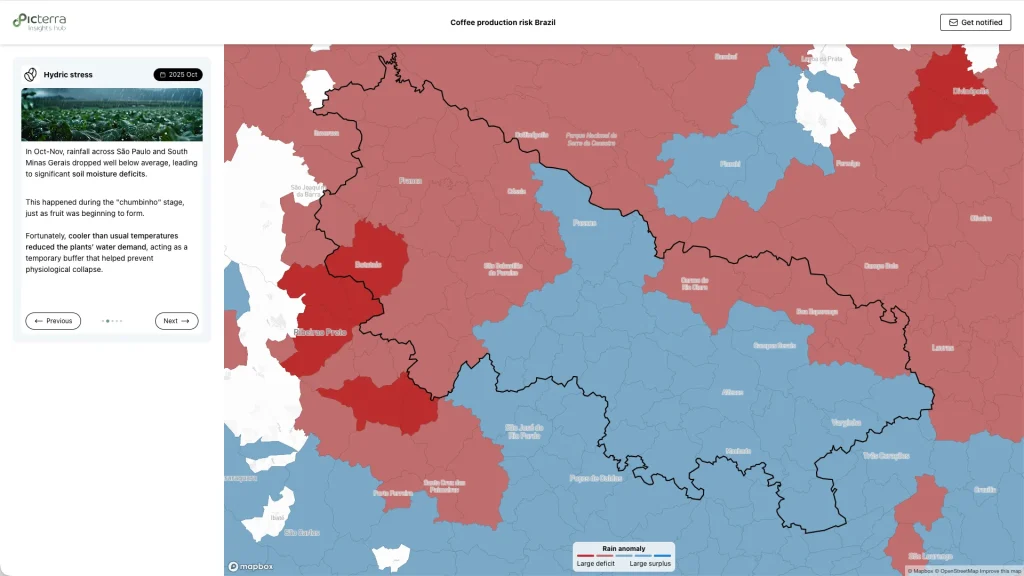
The first signal emerged during the “chumbinho” stage, between October and November, when coffee plants transition from flowering to early fruit development. This is a sensitive phase in which sufficient soil moisture is essential to support fruit set and early growth.

Rainfall deficit map São Paulo and Minas Gerais October 2025 showing hydric stress during fruit formation

Across São Paulo and southern Minas Gerais, rainfall dropped well below historical norms. The resulting soil moisture deficit came at precisely the moment when the plant’s demand for water was increasing. Under typical conditions, this would lead to widespread stress and fruit loss.

However, cooler-than-average temperatures during this period played an important role in moderating the impact. Lower temperatures reduced evapotranspiration and slowed plant metabolism, effectively easing the immediate pressure on the crop. The system did not collapse, but it entered the next phase already under strain.

Escalation: the December heat spike

In December, conditions shifted.

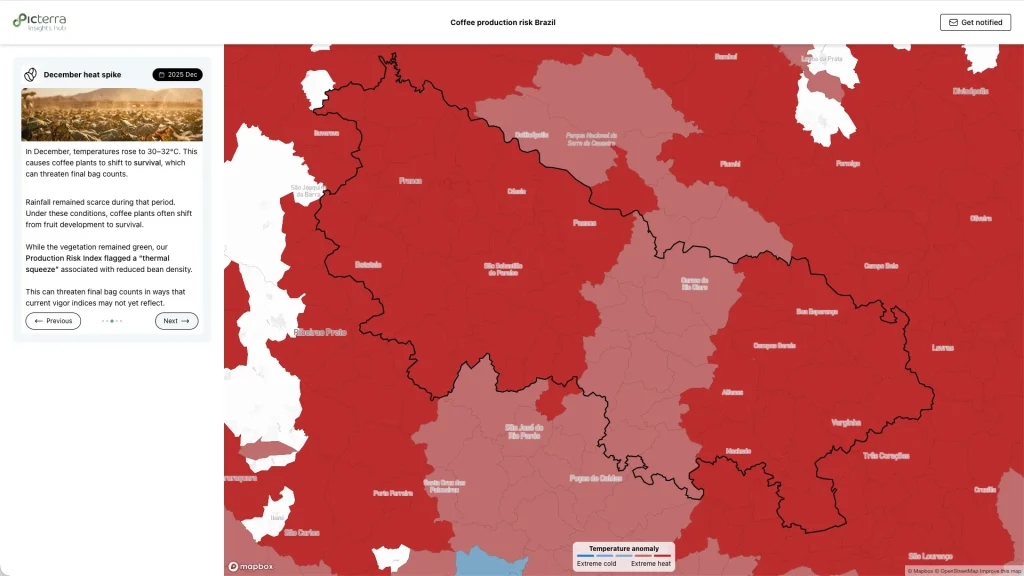
Temperatures rose to between 30 and 32°C, while rainfall remained limited. This combination of heat and moisture deficit represents one of the most critical stress scenarios for coffee plants, particularly during early fruit development. At this stage, the plant is forced to make a physiological trade-off, redirecting energy away from fruit growth toward survival.

Temperature anomaly map Brazil December 2025 showing extreme heat impacting coffee regions

Visually, the crop remained relatively stable. Canopies stayed green, and vegetation indices did not show a sharp decline. But the Production Risk Index detected a different signal, highlighting a “thermal squeeze” where environmental pressure increased while biological performance began to weaken.

This type of stress is not always immediately visible, but it can have lasting effects, particularly on bean density and final yield potential.

Stabilization: a recovery that masks earlier stress

From mid-January into February, weather conditions became more favorable. Increased cloud cover, more consistent rainfall, and moderate temperatures supported the grain-filling stage, allowing the crop to stabilize and maintain strong vegetative vigor.

This phase has driven much of the current optimism around the 2026 harvest. At a surface level, the crop appears healthy, with dense canopies and active growth across many regions.

But this visible recovery does not erase what came before it.

The earlier combination of hydric stress and heat exposure has already influenced how the plant allocated its resources during critical development stages. In some areas, the system absorbed this pressure and continued on a stable trajectory. In others, the impact is more subtle but still present, reflected in reduced fruit set or lower productive efficiency.

What the data reveals

When these signals are aggregated across regions, a more nuanced picture of the 2026 season begins to emerge.

At the national level, the conditions for a strong harvest remain in place. Many areas show stable vegetation, and the recovery phase in early 2026 has supported continued crop development. This aligns with the broader narrative of increased production and helps explain why forecasts remain high.

But beneath that aggregate view, the data reveals a growing divergence.

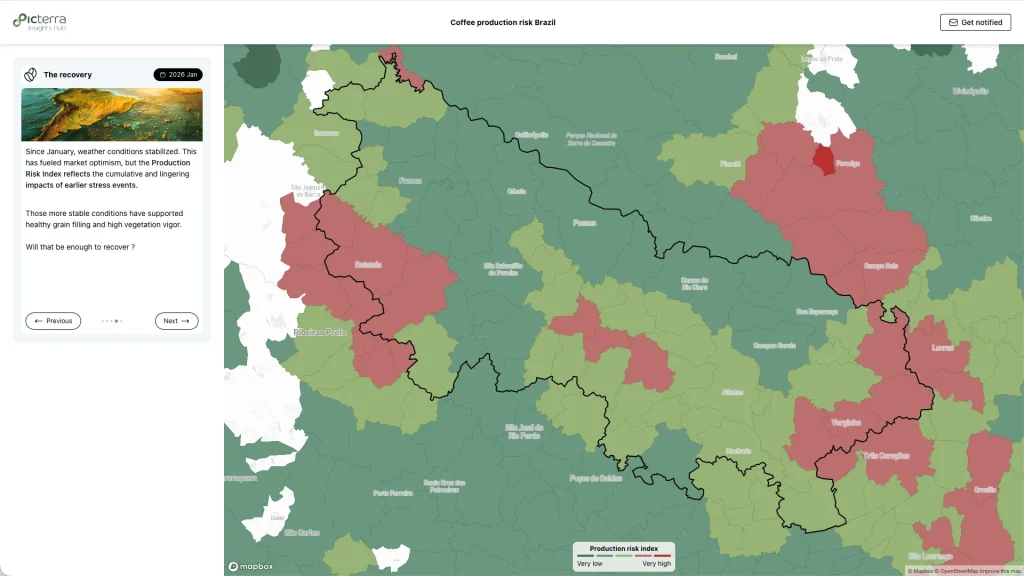
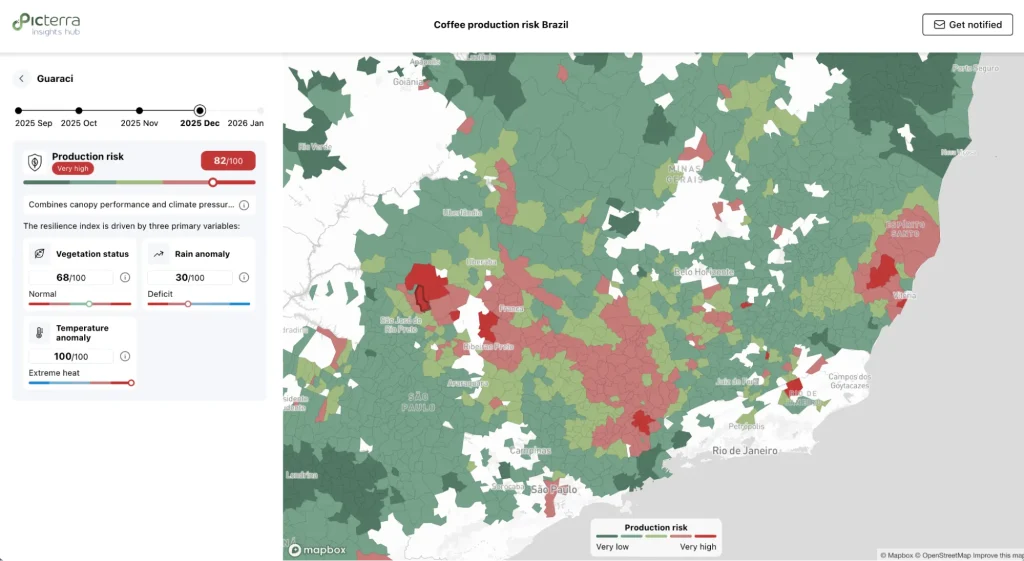
Across the Sul de Minas and Alta Mogiana coffee regions, the Production Risk Index highlights clear differences in how the crop responded to the same sequence of climatic events. In some areas, coffee systems maintained stable performance despite the rainfall deficit and subsequent heat, indicating greater resilience. In others, the same conditions led to a measurable weakening in biological response, suggesting that stress had already begun to affect the crop’s productive capacity.

Brazil coffee regions showing mixed production risk levels highlighting uneven crop resilience
In Guaraci, the Production Risk Index is very high due to extreme heat and rain deficit
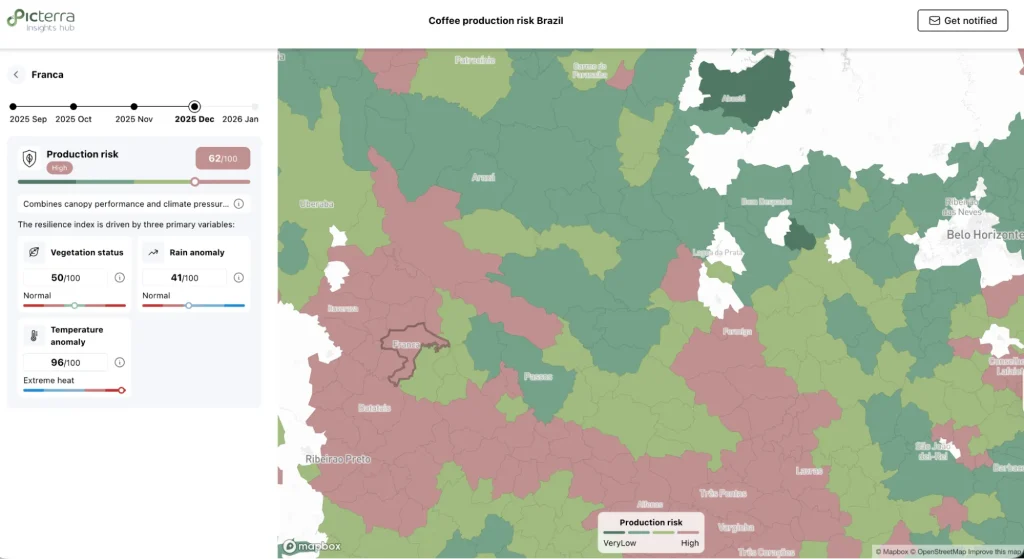
Brazil coffee regions showing mixed production risk levels highlighting uneven crop resilience
In Franca, the Production Risk Index is high due to extreme heat

This divergence is not always visible in traditional indicators. Vegetation levels may appear similar across regions, particularly after the recovery phase. But the underlying trajectory of the crop is different.

In more resilient areas, the system absorbed early stress without significant disruption, allowing fruit development to continue along expected patterns. In more vulnerable areas, the combination of hydric stress during fruit formation and thermal pressure in December appears to have altered that trajectory, with likely implications for fruit set, bean development, and overall yield efficiency.

These patterns closely align with observations from the field. Reports of abortamento, uneven fruit set, and lower-than-expected yields are consistent with the types of stress detected in the analysis. What the data adds is structure. It shows where these effects are concentrated, how they evolved over time, and how they differ across regions that might otherwise appear similar.

The result is not a contradiction of the record harvest narrative, but a refinement of it.

Production may still be high at the national level. But it is unlikely to be uniform. Variability is already embedded in the system, shaped by events that are no longer immediately visible but still influence the final outcome.

What this means for understanding production risk

The key takeaway from this analysis is not whether Brazil will achieve a record harvest. It is that production risk is already unevenly distributed across regions, and that this variability is largely invisible in conventional indicators.

This matters because most decisions across the coffee value chain are still anchored in aggregated signals. Forecasts, pricing expectations, and sourcing strategies often rely on national outlooks or general assumptions about crop conditions. These views are useful, but they often miss the underlying dynamics that shape how production actually materializes.

This analysis shows that risk does not emerge at the point of harvest. It builds gradually, through a sequence of stress events that affect the crop at different stages of development. By the time yield variability becomes visible in production data, the opportunity to anticipate and respond has already passed.

A resilience-based approach changes that timing.

By evaluating how the crop responds to environmental pressure throughout the season, it becomes possible to detect where productive capacity may already be constrained, even when vegetation still appears healthy. This does not replace traditional forecasts, but it adds a forward-looking layer that helps explain where those forecasts may be more or less reliable.

For sourcing and procurement teams, this translates into a clearer understanding of where variability is likely to originate. Regions that appear similar in aggregate may carry very different levels of underlying risk. Identifying those differences earlier allows for more informed decisions around supplier engagement, volume planning, and exposure to potential shortfalls.

For traders and market participants, it provides additional context to interpret price movements and production expectations. A strong national outlook does not eliminate localized constraints, and those constraints can influence availability, quality, and timing in ways that are not immediately reflected in headline numbers.

More broadly, it reinforces a shift in how crop performance is understood. Weather anomalies alone do not determine outcomes. What matters is how the crop responds and whether it can maintain stable development under pressure.

This is the perspective that the Production Risk Index is designed to capture. Not as a prediction of yield, but as a structured signal of how the season is evolving beneath the surface.

You can explore these patterns in detail through our first public GeoAI insight, built with Picterra Insights Hub, and follow how the situation evolves as new data becomes available. We will continue to monitor the season and update the analysis as conditions change, providing a clearer view of how early signals translate into final outcomes.

Discover more

Access the interactive story map, learn new insights, and explore the data

Related articles